

Spanish Supreme Court Double Shot Doctrine: Can Tax Authorities Try Again?
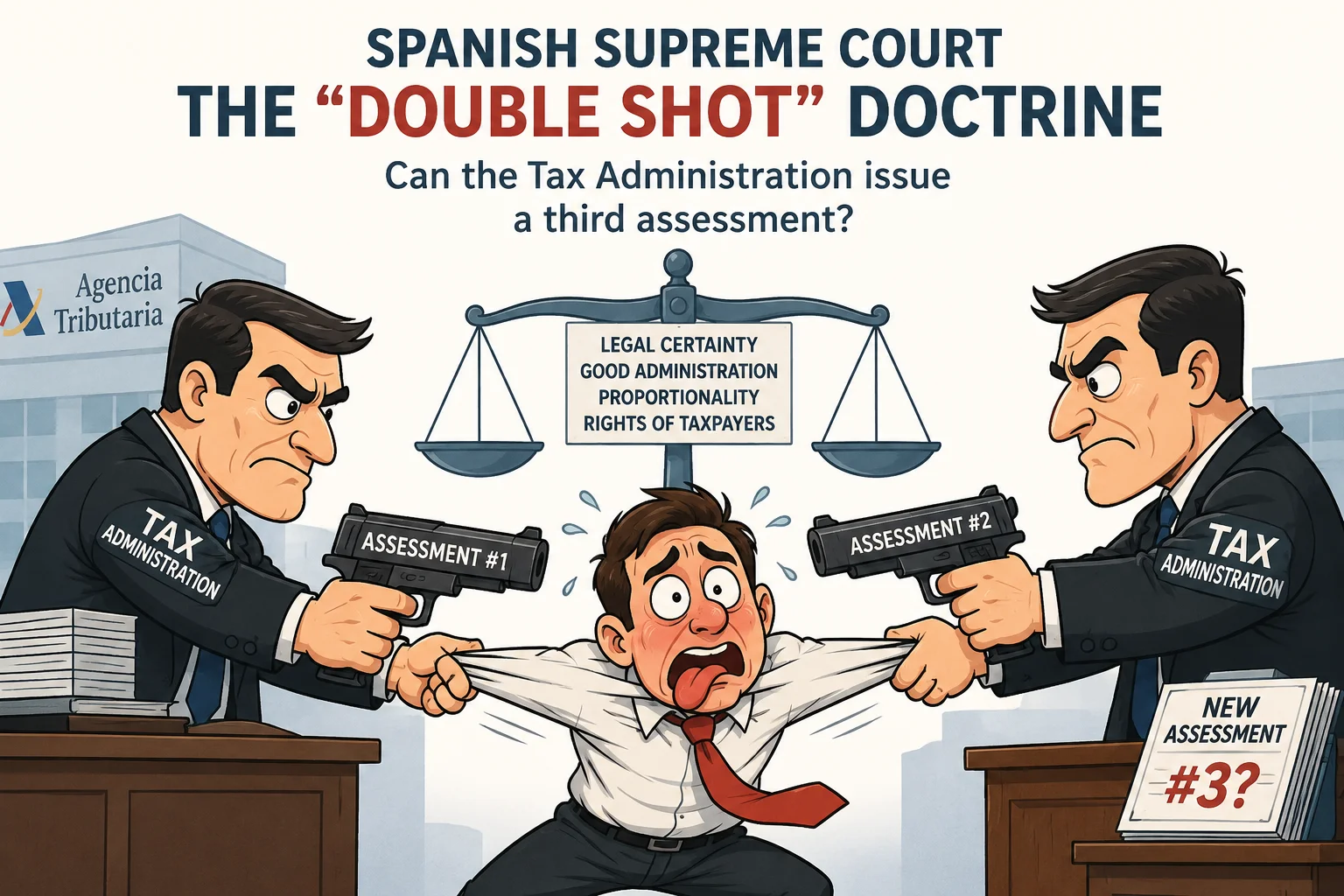
A question that matters for every taxpayer
Can the Spanish Tax Administration continue issuing new tax assessments after previous ones have been successfully challenged?
This question lies at the heart of one of the most debated areas of Spanish tax procedure: the Spanish Supreme Court's so-called "doble tiro", or "double shot", doctrine. While the expression is unique to Spanish legal practice, the underlying issue is straightforward: how many opportunities should the Tax Administration have to correct its own mistakes?
The debate is about more than tax collection. It concerns the balance between the State's power to enforce tax laws and the taxpayer's right to legal certainty, good administration and proceedings that do not continue indefinitely.
Why the issue exists
The controversy arises when the Tax Administration issues a tax assessment that is later annulled because it contains legal or procedural defects.
Under Spanish administrative law, not every defect has the same legal consequences. Generally speaking, two situations may arise:
- Nullity, where the defect is so serious that the assessment is considered legally ineffective.
- Annulability, where the assessment is defective but may still allow the Administration to correct the error and issue a new assessment.
It is this second situation that has generated years of litigation. If each defective assessment can simply be replaced by another, taxpayers may find themselves facing repeated proceedings while the Administration continues trying to produce a legally valid assessment.
The risk of endless reassessments
The article published by Juan Antonio Mosquera Pena highlights the practical concern behind the Supreme Court's case law.
Without clear limits, the Tax Administration could repeatedly issue new assessments after earlier ones had been annulled. Each new administrative action could interrupt the limitation period, extending the dispute for years.
From a taxpayer's perspective, this creates significant uncertainty. Businesses and individuals may remain involved in lengthy administrative and judicial proceedings without knowing when the dispute will finally come to an end.
This tension explains why the courts, not the legislature, have played such an important role in developing the legal principles governing repeated tax assessments.
The balancing exercise
The Spanish Supreme Court has had to reconcile competing legal principles.
On one side are legitimate public interests, including:
- The effective collection of taxes.
- The constitutional duty to contribute to public expenditure.
- Administrative efficiency.
On the other side are equally important taxpayer protections, such as:
- Legal certainty.
- Good administration.
- Proportionality.
- The right to proceedings without undue delay.
The challenge has always been determining where the balance should be drawn.
The Supreme Court's "double shot" doctrine
The doctrine commonly referred to as the "double shot" doctrine seeks to prevent the Administration from having unlimited opportunities to correct defective assessments.
Rather than allowing administrative proceedings to continue indefinitely, the Supreme Court has gradually developed principles that place limits on repeated reassessments.
As the source article explains, this area of law has evolved primarily through judicial decisions rather than detailed legislation. The result has been an extensive body of case law that has generated considerable academic debate, differing judicial opinions and, on occasion, conflicting interpretations.
Can the tax authorities issue a third assessment?
One of the central questions examined in the source article is whether, after two unsuccessful attempts, the Tax Administration may issue a third tax assessment.
The article explains that this issue has been one of the most controversial areas of Spanish tax litigation. Rather than establishing an absolute rule applicable to every situation, the Supreme Court's jurisprudence has evolved over time through successive decisions analysing the particular circumstances of each case.
Consequently, the answer depends on the legal basis on which previous assessments were annulled and the procedural context in which the Administration seeks to issue a further assessment.
Taxpayers should therefore review each new assessment carefully against limitation periods, prior annulment grounds and the principles of legal certainty and good administration.
Why this matters for businesses
For companies operating in Spain, the issue is far from theoretical.
Repeated tax assessments may involve:
- Prolonged inspections.
- Increased litigation costs.
- Uncertainty in financial reporting.
- Delayed tax certainty for investors.
- Significant management time responding to repeated proceedings.
Understanding the limits of the Administration's powers is therefore an essential element of effective tax compliance in Spain and broader tax risk management.
Practical lessons for taxpayers
The Supreme Court's jurisprudence demonstrates that taxpayers should not assume that a new assessment issued after an earlier annulment is automatically valid.
Each case requires careful analysis, including:
- The reason the previous assessment was annulled.
- Whether procedural defects have been corrected.
- Whether limitation periods have expired.
- Whether constitutional principles such as legal certainty have been respected.
- Whether the Administration is acting within the limits established by the courts.
Early legal advice may significantly improve a taxpayer's position when challenging repeated assessments, especially in matters connected with corporate taxes in Spain, personal taxes in Spain, Spanish VAT or formal filing obligations such as corporate tax forms and freelancer tax forms.
How Strong Law and Compliance can help
At Strong Law and Compliance, we advise Spanish and international clients in complex tax disputes and administrative litigation.
Our services include:
- Challenging tax assessments.
- Administrative appeals.
- Proceedings before the Economic-Administrative Tribunals.
- Judicial tax litigation.
- Tax inspections.
- Cross-border tax matters.
- Strategic tax risk management.
We work with businesses and private clients to protect their rights while seeking practical and commercially effective solutions. We can also assist with related requirements such as obtaining a Spanish tax identification number or coordinating recurring accounting support in Spain.
Frequently asked questions
- What is the "double shot" doctrine?
It is the name commonly used in Spain to describe the Supreme Court's case law governing repeated tax assessments after previous assessments have been annulled. - Can the Tax Administration always issue another assessment?
Not necessarily. Whether a further assessment is lawful depends on the legal circumstances and the applicable case law. - Why is this doctrine important?
It seeks to balance the State's power to collect taxes with taxpayers' rights to legal certainty and fair administrative proceedings. - Does the law expressly regulate this issue?
As highlighted in the source article, much of this area has been developed through judicial decisions rather than detailed statutory rules. - Should businesses challenge repeated tax assessments?
Each case should be analysed individually. Repeated assessments may raise significant procedural and substantive legal issues.
Conclusion
The Spanish Supreme Court's "double shot" doctrine illustrates the delicate balance between efficient tax administration and the protection of taxpayers' rights.
As the case law continues to evolve, businesses and individuals should carefully assess any repeated tax assessment rather than assuming that the Administration may issue successive decisions without limitation.
Obtaining specialist legal advice at an early stage can often be decisive in protecting taxpayers' interests and avoiding prolonged disputes.
Disclaimer: This article is intended for general informational purposes only and should not be regarded as legal advice. Each tax dispute depends on its specific facts and applicable law.
Author note
Pura Strong is Spain's leading expert in anti-money laundering (AML), a certified SEPBLAC specialist, and President of the Anti-Crime Certification Institution. She is an author, media commentator and fearless advocate known for denouncing corruption and surviving it.
Pura Strong