



EU Pay Transparency Directive (EU) 2023/970 in Spain: What Employers Need to Know
Quick summary
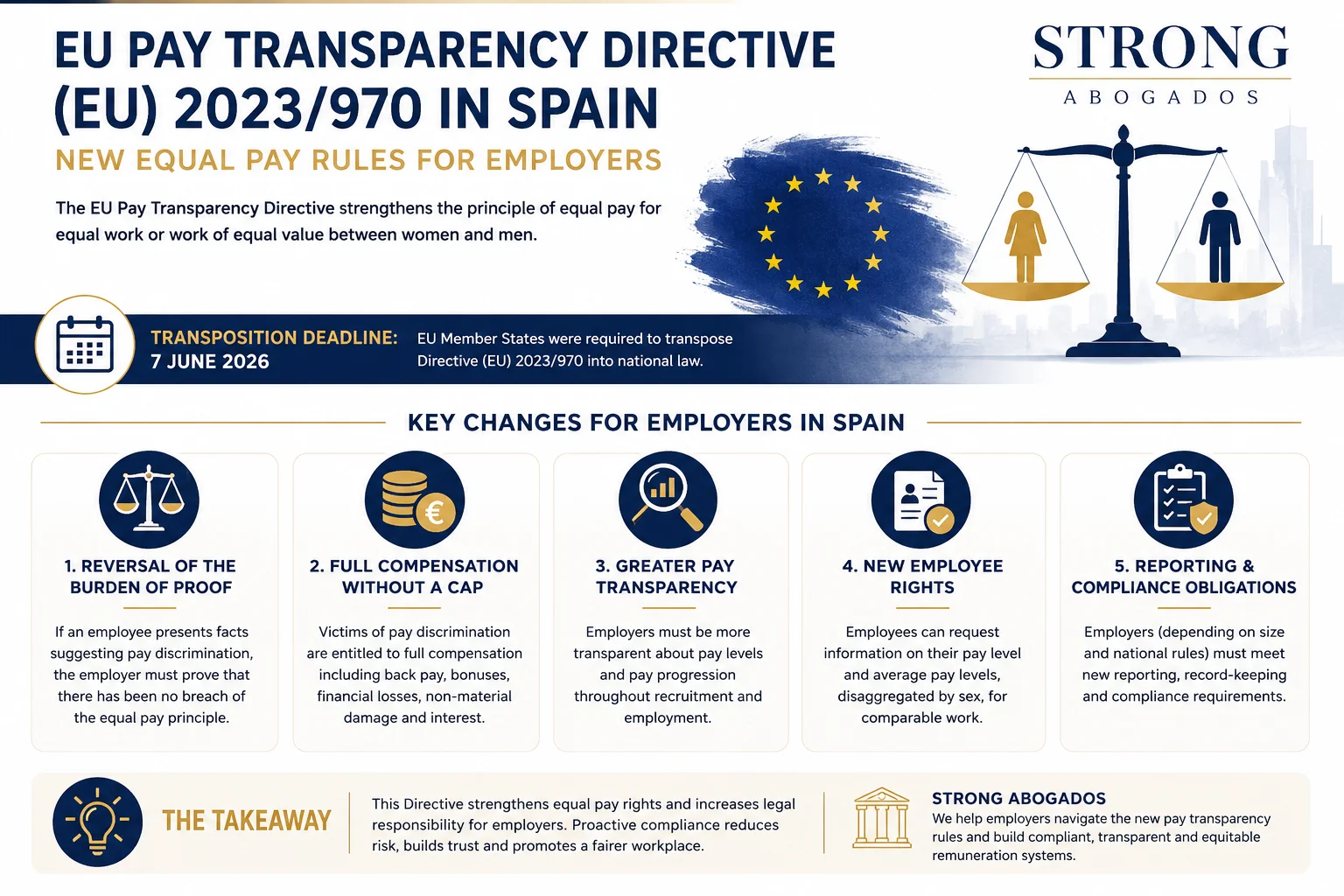
The EU Pay Transparency Directive, formally Directive (EU) 2023/970, is one of the most important recent developments in European employment law. It strengthens the principle of equal pay for equal work or work of equal value between women and men through pay transparency measures and stronger enforcement mechanisms.
The deadline for EU Member States to transpose the Directive into national law was 7 June 2026. For employers operating in Spain, the message is clear: salary structures, job evaluation systems, pay records and HR documentation should now be reviewed with care.
What is Directive (EU) 2023/970?
Directive (EU) 2023/970 was adopted by the European Parliament and the Council to make equal pay rights more effective in practice. Its purpose is not only to prohibit discriminatory pay, but also to make remuneration systems more transparent so that workers can identify and challenge unjustified pay gaps.
The Directive applies across the public and private sectors and covers a broad concept of pay, including salary and other direct or indirect remuneration linked to employment.
How does it affect employers in Spain?
Spain already has a developed equal pay framework, including salary registers, pay audits in equality plans and rules on equal remuneration under Spanish employment law. The Directive builds on that existing framework by reinforcing transparency, access to information, remedies and procedural protections.
Employers should therefore review both their current Spanish obligations and the additional standards introduced by the Directive, especially where they have complex remuneration systems, variable pay, bonuses, benefits, promotions or international reporting lines.
1. Reversal of the burden of proof
One of the most significant changes concerns equal pay litigation. Once a worker presents facts that may indicate pay discrimination based on sex, the employer may have to prove that there has been no breach of the equal pay principle.
This procedural shift makes evidence essential. Employers should be able to show that salary differences are based on objective, gender-neutral criteria, supported by documents and applied consistently across the workforce.
Useful evidence may include job evaluation systems, remuneration policies, promotion criteria, performance assessments, salary bands and records explaining variable compensation decisions.
2. Full compensation without a statutory cap
The Directive also strengthens employee remedies. Where pay discrimination is established, victims must be able to obtain full compensation or reparation for the loss and damage suffered.
Depending on the case, compensation may include outstanding salary differences, bonuses, benefits, interest, financial losses and non-material damage where applicable under national law. The Directive requires that compensation cannot be limited by a predetermined maximum cap.
3. Greater pay transparency
Employers will need to pay close attention to transparency throughout the employment relationship. This starts before recruitment and continues during employment, especially where workers request information about their pay level and average pay levels for comparable work.
The Directive also restricts practices that make pay discrimination harder to detect, such as unnecessary secrecy around remuneration where workers need information to enforce equal pay rights.
4. Objective job evaluation and pay structures
Equal pay compliance depends on comparing work of equal value. Employers should therefore ensure that job classification and remuneration structures are based on objective, gender-neutral factors such as skills, effort, responsibility and working conditions.
This is especially important in organisations where pay has grown organically over time through individual negotiation, legacy arrangements or informal manager discretion.
5. Reporting and compliance obligations
The Directive introduces reporting and record-keeping measures that may vary depending on employer size and national implementation. Businesses should monitor the Spanish rules applicable to their workforce and prepare the data needed to demonstrate compliance.
For larger employers, this may include reviewing gender pay gap information, identifying unjustified differences and documenting corrective measures where needed.
Why businesses should review their policies now
The new framework increases legal and reputational risk for employers that cannot explain salary differences with objective evidence. The practical response is proactive compliance, not waiting for a dispute.
Businesses should consider carrying out:
- Equal pay audits and remuneration reviews.
- Checks of salary bands, bonuses and benefits.
- Reviews of recruitment and promotion procedures.
- Updates to HR policies and manager guidance.
- Documentation of pay decisions and job evaluation criteria.
- Training for HR teams and managers involved in salary decisions.
How Strong Law and Compliance assists employers
At Strong Law and Compliance, we advise Spanish and international companies on employment law, executive remuneration, labour compliance and workplace investigations.
Our team can assist with pay transparency compliance, equal pay audits, HR policy reviews, labour inspections, employment litigation, executive compensation and cross-border employment matters.
Related services include labour law advice in Spain, payroll compliance, hiring employees in Spain and Spanish employment contracts.
Frequently asked questions
- Does the Directive apply to all employers?
The Directive applies across both public and private sectors, although some reporting obligations depend on employer size and the applicable national rules. - What happens if an employer cannot justify salary differences?
If unjustified pay discrimination is established, employers may face liability for full compensation and other remedies available under national law. - Why is the burden of proof important?
It changes the dynamics of litigation. Once discrimination is plausibly indicated, the employer may need to demonstrate that its pay practices comply with the equal pay principle. - Can compensation be capped?
No. The Directive requires full compensation or reparation without a predetermined statutory maximum cap. - Should employers wait before reviewing their policies?
No. Employers should proactively assess remuneration systems and supporting documentation to reduce legal risk. - Does Spain already regulate equal pay?
Yes. Spain already requires equal pay measures, including remuneration registers and equal pay obligations. Directive (EU) 2023/970 strengthens and complements that framework through enhanced transparency and enforcement.
Official sources
- BOE: Directive (EU) 2023/970
- EUR-Lex: Directive (EU) 2023/970
- Spanish Ministry of Equality: equal pay regulations
Conclusion
Directive (EU) 2023/970 reinforces pay transparency, reverses the burden of proof in key equal pay disputes and guarantees effective compensation for victims of discrimination. For employers in Spain, this is a practical compliance issue requiring clear policies, reliable data and objective pay structures.
Early review reduces litigation risk, improves governance and helps build a more transparent and equitable workplace.
Disclaimer: This article is intended for general informational purposes only and does not constitute legal advice. Professional advice should always be obtained for specific circumstances.